Before the arrival of the AI era—or, more recently, before 2026—we had always operated under a relatively stable mode of product and R&D collaboration: product managers propose requirements, designers work out solutions, and developers complete implementation. But this year, everything has changed.
In the past, no matter how accurately a product's requirements were anchored, or how perfectly a designer handled the experience, interaction, and visual design, a solution could not be implemented; it still depended on developers' coding and implementation capabilities to complete a true project loop. I do not deny that even now developers remain very important, but this year's Agent has shortened this validation cycle from one or two months to a few days, and Codex is one of these many examples.
Codex appears
Codex's GUI App officially launched in February this year. Its excellent design language and simple GUI experience that matches users' mental models quickly won over a large number of users. As of now, it has far surpassed Claude Code's user base, breaking through the 10 million mark.
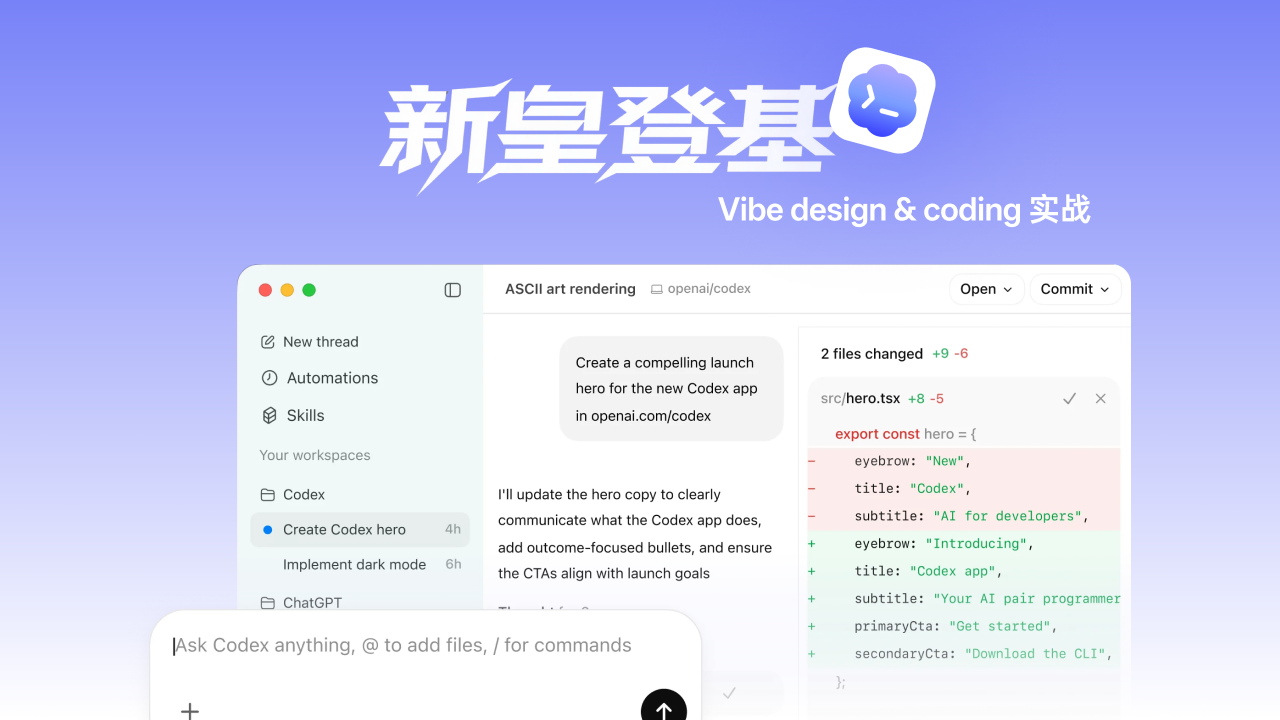
So why is Codex so widely loved? Being easy to use is only enough to retain users—what truly attracts users to use it? That is what I mentioned earlier: Codex's powerful capabilities.
What changes has Codex brought?
Almost all of my friends working in the internet industry are using Codex, and some also use other Agent tools. Everyone has done a lot of things with Codex:
Using Codex to create Skills and Plugins, helping themselves complete many mechanical tasks in a more automated way;
Using Codex to develop browser and Figma plugins to help improve efficiency at work;
Using Codex to develop their own personal websites, deploy their own projects, and create prototypes or front-end interface effects at work for convenient demonstration and coordination with upstream and downstream teams, and so on.
These things were almost impossible before. You do not need to spend a large amount of time—perhaps several months to one or two years—learning coding and engineering knowledge. Moreover, different development efforts use different code tech stacks and engineering standards, which means that to achieve the above, you might need to learn more than many developers do. But Codex makes these things simple and fast. This is the endless charm of Codex. I have seen many people use Codex to become a group called "Builder".
If you are a non-developer, you are even more encouraged to learn Codex
Take designers and product managers as examples. In fact, the core work of these two roles is essentially not "making interfaces," but continuously making decisions and trade-offs.
When implementation costs decrease, these decisions no longer have to wait until the development stage to be validated; instead, they can be "run out and seen" in advance. This means design judgment begins to gradually shift from experience-driven to outcome-driven.
Setting aside these two roles, which already have some contact with development, I have also seen many people in sales and marketing use Codex to help them tag customers, automatically send emails, and so on, giving themselves more time to visit customers and study customers. These are all great application cases.
In my view, Codex is not exclusive to developers—that is precisely where its value lies. It helps many people who don't understand code to start writing code (even if the quality of that code may be questionable), using code to help them complete or realize some dreams. That is Codex.
Writing This Tutorial
Codex, as a tool, changes too fast, but the core knowledge of using it will not change—unless it is eliminated by this era. I got to know Codex relatively early. As a designer not from a development background, I don't understand code, let alone engineering constraints; I have blazed this trail one pitfall at a time, and I hope I can help others avoid so many detours.
This tutorial is not long—I estimate it is under 1W words. I also adjusted the order of the articles several times before settling on it, because I want your learning curve to be smooth, gradual, and with every step being exactly what you need at that moment. I don't want it to be like code—a steep and lengthy learning curve—which would make you bored and give up. After more than half a year of iteration, Codex has changed dramatically from its original form, and many features have been added, but I want to teach you the final thing, the most core thing, and leave the infinite possibilities of the remaining application layer for you to explore.
Thank you for being willing to read this far. I sincerely hope this article is helpful to you, and I wish you success in using Codex to build many excellent products and small creations!
32 likes
You can like once today